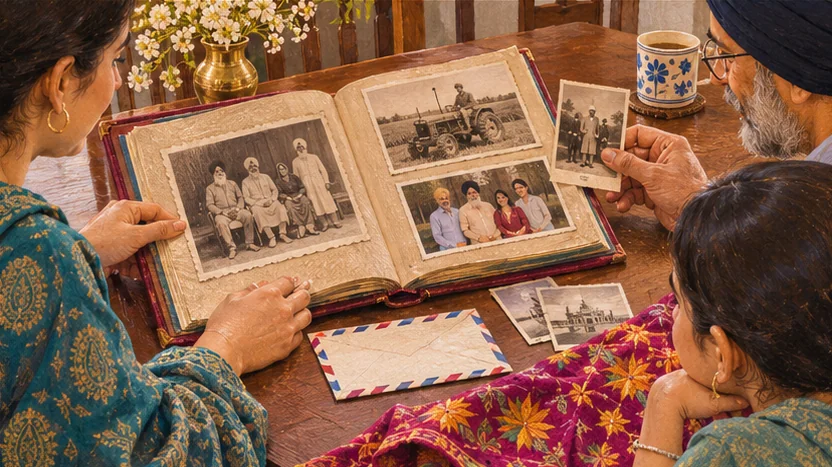
Pardes di kahani school di tasveer, chitthi, cassette jaan mehfil de programme vich sambhali ho sakdi ae. Kamyabi de naal ikallapan, dosti, mehnat ate apnapan vi archive da hissa ne. Britain da SADAA ate Canada da South Asian Canadian Digital Archive Punjabi jeewan nu vaddi South Asian yaad de andar naa ate sarot samet rakhde ne. Ikk naa-wali interview, recording di tareekh ate speaker di marzi anonymous kahani ton vadh samajh dinde ne. Ghar di tasveer vich kaun ae, ajj hi buzurg kolon likh lao. Asal file sambhalo, lagbhag tareekh nu lagbhag hi likho ate janatak karan di ijazat saaf rakho.
Eh Punjabi saar tuhanu poore khoj-lekh wal lai janda ae. Tafseel ate hawale hethaan parho. Je tuhade ghar, pind jaan muhhalle di yaad is naal jurdi ae, taan apna tajurba thaan te same de naal sanjha karo; nijji yaad ate tasdeeq-shuda tareekh nu vakh pachhano.
Poora khoj lekh — English
A family history abroad is often kept in ordinary things: an envelope, a school photograph, a programme from a performance, a cassette or a letter from home. These objects can connect a Punjabi village or city to another country without reducing migration to a single success story. Work, friendship, art, loneliness and belonging can all sit in the same collection.
In Britain, the South Asian Diaspora Arts Archive began in 1999 as SALIDAA, formed by people concerned that writers’ and artists’ work was disappearing or becoming inaccessible. Its collections span literature, scripts, dance, music, painting and poetry. Punjabi work belongs within this wider South Asian story, while retaining its own language, places and makers. SADAA records becoming part of Birmingham Museums’ collection in April 2025; physical archive visits require an appointment.
Canada offers another model. The South Asian Canadian Digital Archive, an initiative of the University of the Fraser Valley’s South Asian Studies Institute, works with families, individuals and memory institutions to digitise and describe heritage materials. Its scope is pan-Canadian and broader than Punjab. A catalogue can bring different collections into conversation while keeping the repository, creator and rights information attached to each item.
One Punjabi-language example is the archive’s interview with Indar Singh Gill, recorded on 27 August 1996. The catalogue describes his birth in Punjab in 1913 and his arrival in Canada with his brothers in 1930. A named interview with a recording date gives future listeners a specific person’s account, rather than an anonymous story standing for all migrants.
You can begin at home by asking who appears in a photograph and writing the answer down while someone still knows. Keep original spellings and add another spelling only as a guide. Record approximate dates honestly, preserve the original file or object, and agree what may be made public. A public archive grows from these small acts of attention. The goal is not to make every Punjabi life look alike; it is to let more lives remain visible.