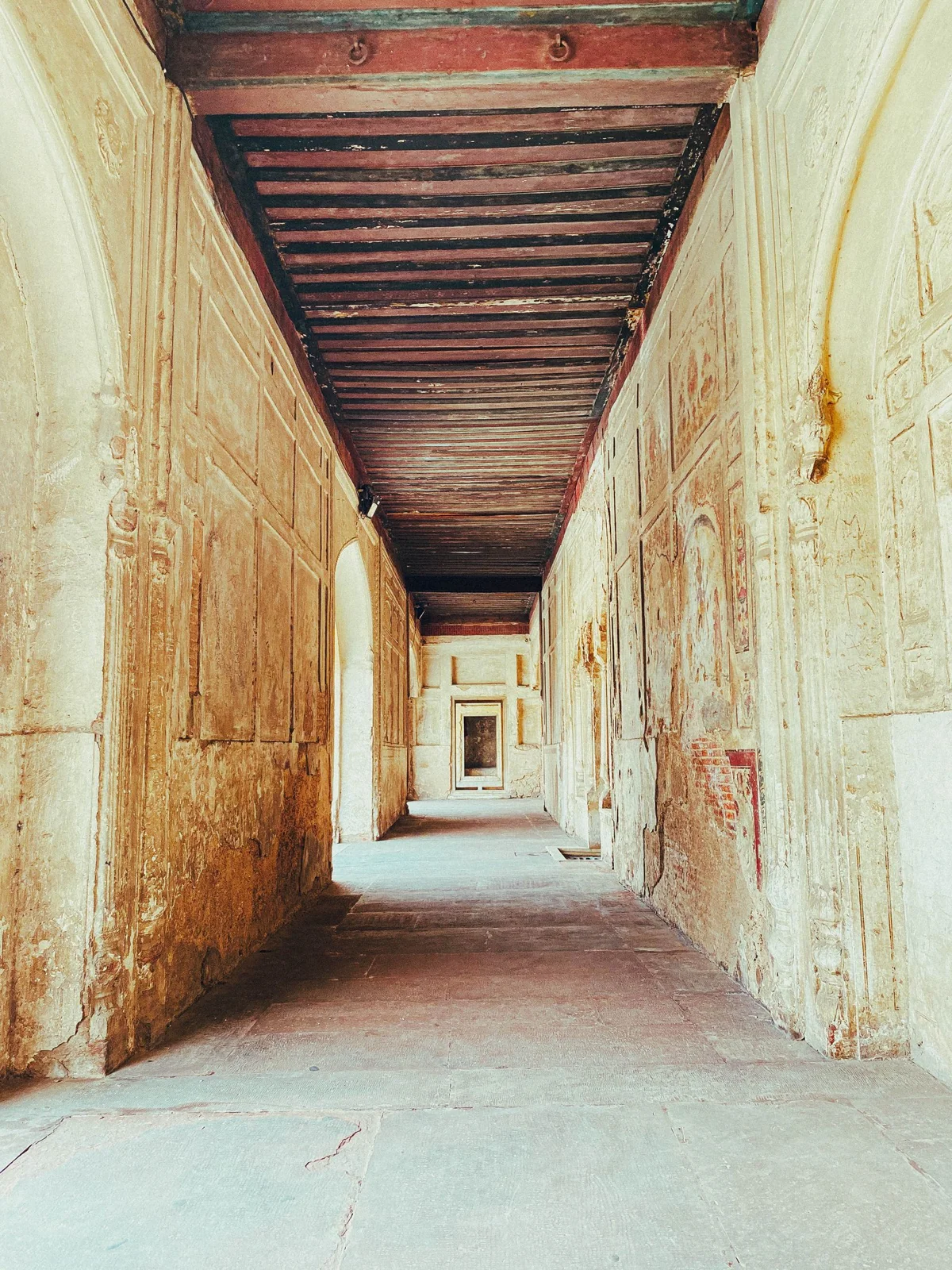
A fort built more than once
At the northwestern edge of Lahore’s Walled City, a fortified site stood long before Akbar. The buildings within the walls today preserve several generations of Mughal work. At the Masjidi Gate, two bastions frame an entrance built under Akbar. Brick and red sandstone gave builders strong surfaces into which they could set carved brackets. A gate announced who controlled the city. An audience hall controlled how visitors approached the ruler.
From Jahangir’s courtyard to Shah Jahan’s mirrors
Jahangir completed the large northern court begun under Akbar and commissioned decoration on the outer walls. A generation later, Shah Jahan’s builders worked with marble and glass. In the Shish Mahal, made in 1631–32, tiny pieces of mirror break a reflection into a multitude of points. Marble screens admit light in a different way. Look at the materials as you move from one court to the next and the changes in taste become legible.
The fort and its gardens
UNESCO lists the fort together with the Shalamar Gardens, a separate site in Lahore. Shah Jahan commissioned the gardens in the 1640s. Their terraces and waterworks offer a companion to the buildings inside the fort. Each required craftsmen who could set out a precise plan on the ground and then make it work in stone, plaster or water.