August 1947 vich British raaj mukkya te India ate Pakistan bane. Punjab do hissiyan vich vandya gaya; Radcliffe da boundary faisla 17 August nu janatak hoya. Hinsa te beyaqeeni de vich lakhhan parivaar ghar chhad ke nikle. Musalman Pakistan val, te bahut saare Hindu te Sikh India val gaye. Jaanaan, ghar te rozgaar da bhaari nuksan hoya. Kise ik parivaar di yaad poori tareekh nahi, par oh tareekh de andar di zindagi zaroor dikha sakdi hai. Madad te bachaa diyan kahaniyan vi suniye, te zulm de dukh nu vi na lukaiye. Har yaad naal dassiye ke gall apni akhin vekhi si jaan baad vich suni. Gunah da bojh ajj de poore bhaichare utte paun di thaan, gawahi nu sambhal ke samjhiye.
Poora khoj lekh — English
A province divided
In August 1947 British rule ended and the new states of India and Pakistan came into being. Punjab was divided between them. The boundary award associated with Cyril Radcliffe was made public on 17 August, after the independence ceremonies. The division took place amid political conflict, communal violence and uncertainty about the future. For many families the question was immediate and physical: could they stay, where could they go, and who would survive the journey?
Millions crossed the new borders. Muslims moved towards Pakistan, while many Hindus and Sikhs moved towards India. Deaths, abductions, sexual violence, the destruction of homes and the loss of livelihoods scarred the region. Estimates of the total human cost vary, so a responsible account should identify the estimate it uses rather than present one disputed number as exact. The archive sources linked here offer different ways into the evidence.
The lives inside the event
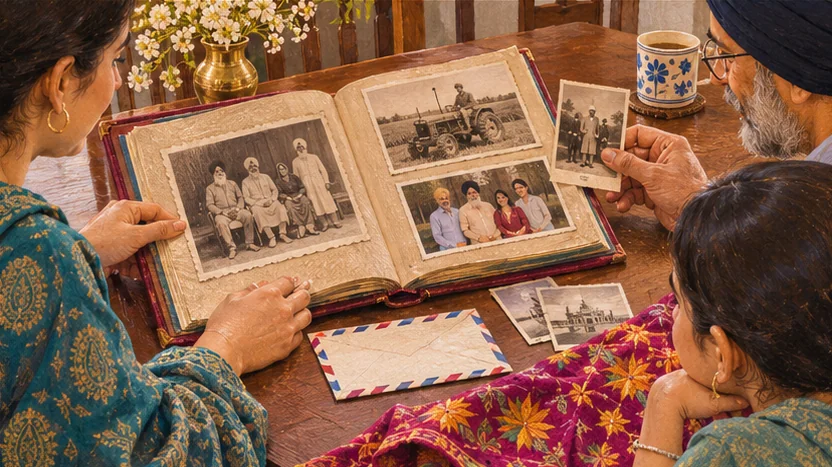
The Partition Museum collects objects carried by displaced families, from practical belongings to things kept for emotional reasons. The Citizens Archive of Pakistan and The 1947 Partition Archive preserve oral histories. These collections help us see an event at the scale of a household: a school left behind, a familiar tree, a neighbour’s warning or a language remembered from a street.
Such memories can include kindness and rescue as well as terror. Neither should be used to cancel the other. A person who remembers help is not disproving the suffering of another family, and a story of violence does not make every member of the perpetrator’s community responsible. The task is to listen precisely, preserve context and keep the individuality of those who lived through the event.
How we will tell it here
Sadda Punjabi Virsa’s historical explainers are editorial articles checked against sources. A reader’s family memory belongs in a separate, clearly identified oral-history or personal-story category. The two can inform one another, but they are not identical kinds of evidence. A recollection recorded decades later may contain valuable detail while leaving uncertainty about a date, a name or a route.
When recording an elder, ask for the place name as they remember it, approximate year, age at the time and whether they witnessed an event or heard about it later. Let them decline a question. Do not press for painful detail, publish a private address or present an allegation about an identifiable person as an established finding.
Remembering 1947 can deepen a shared Punjabi culture when it makes room for Muslim, Sikh, Hindu, Christian and other experiences, including women’s accounts and voices that official histories often overlook. The aim is neither a painless past nor an inherited demand for hatred. It is a more honest memory, carried with care into the relationships we build now.