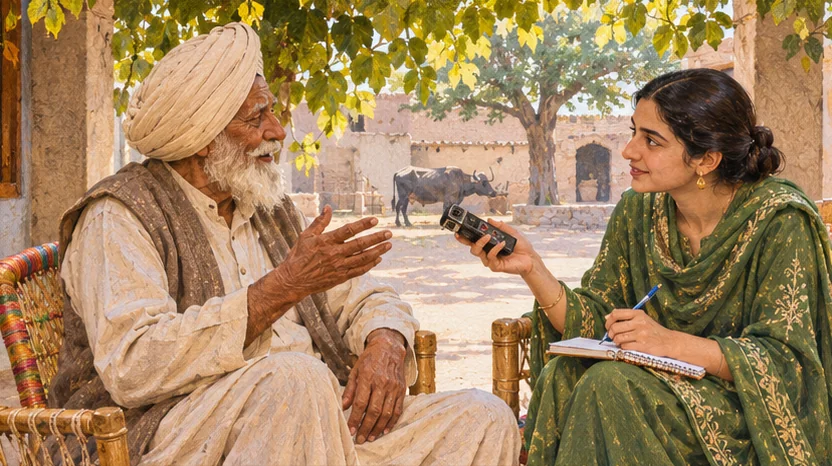
Buzurg di awaaz vich pind da lehja, thahraao te hassa vi sambhal janda hai. Record karan ton pehlan dasso ke kahani kaun sunega te kithe sanjhi hovegi. Gall karan di ijazat te internet utte chhapan di ijazat ikko gall nahi. Chhote sawaalan ton shuru karo: ghar kiven da si, kehri khed khedde si, beej kaun sambhalda si? Aukhi yaad aave taan bande nu rukn da haq deo. Naam, tareekh jaan lafz bare shak hove taan ohnu shak vajon hi likho. Shaant thaan te chhota recording test karo, asli copy sambhalo te janatak copy vich phone number jaan ghar da pata na pao. Chhapan ton pehlan raavi nu parhan jaan sunan da mauka deo, taan jo ohda matlab ohdi apni awaaz vich rahe.
Poora khoj lekh — English
Begin with a conversation
A voice note can preserve something a written summary loses: a familiar pause, a village pronunciation or the way a person laughs before remembering a friend. Begin by explaining what you hope to record and who may hear it. Ask whether the person wants their name, face and voice published. Permission to talk with you is not automatically permission for a public website to distribute the recording.
The Oral History Association recommends preparation, informed consent, preservation and a clear understanding of access. Boston Public Library’s guide explains that participants need to know how a recording will be used and stored. For a family contribution, put those principles into plain words: we can record privately, you can stop, and nothing goes online until the agreed review is complete.
Ask about a life, not only an event
Start with ordinary things. What was your house like? Which tree stood near the well? What did you take to school? Who taught you a game? Which crop or seed did your parents keep? An elder may remember a childhood sound more easily than a formal date, and that sound may open a larger story.
If a difficult period such as 1947 or 1984 arises, allow the narrator to decide how far to continue. Do not make a painful answer the price of being heard. Ask whether they saw something themselves, heard it at the time or learned it later. Record approximate dates honestly. A remembered name can be preserved with a note about uncertain spelling instead of silently changing it.
Make the recording useful
Choose a quiet space and record a short test. Keep the microphone near enough to capture an ordinary speaking voice. State the recording date and general place, along with the narrator’s preferred name. Avoid saying identity numbers, phone numbers or a present home address into a recording intended for publication. Preserve an original copy and make any edited version separately.
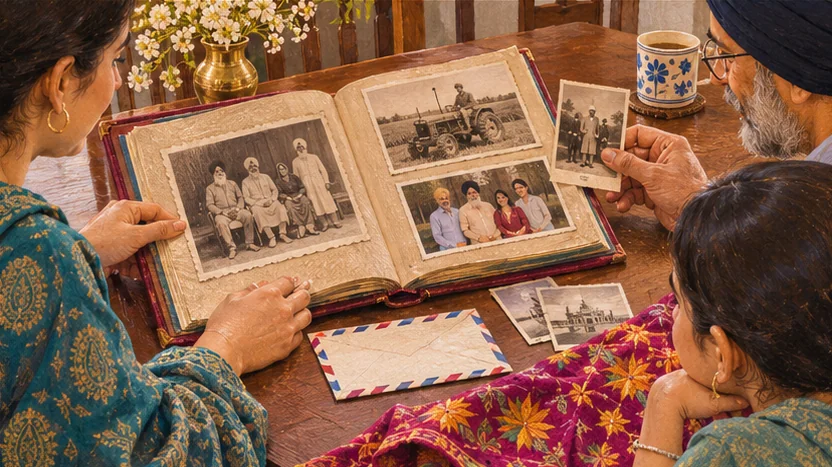
For photographs, ask who is shown, where the picture was taken and who owns it. For a video, ask everyone who can be identified for permission; a child’s contribution needs a parent or guardian’s involvement. Transcripts and captions should be checked with the narrator where possible, especially names, dialect words and translated passages. An uncertain word should remain uncertain rather than being invented.
Share with care
The Citizens Archive of Pakistan and The 1947 Partition Archive demonstrate how personal accounts can contribute to a broader historical record. Their existence is also a reminder that collecting a story creates responsibilities. The narrator should understand the review process, any public access and whom to contact about a concern.
On Sadda Punjabi Virsa, a submitted account should be labelled as personal memory. Editors can help with structure and captions while preserving the speaker’s meaning. Replies should welcome recognition, questions and additional context, with abuse and identifying private information removed. The best response to an elder’s story may be another thoughtful question: what would you like the next generation to remember about the people in that village?