- type
- Throwing, rebuilding and evasion game
- players
- Two teams; local numbers vary
- equipment
- Soft ball and flat stacking pieces
- setting
- Open space with a marked throwing place
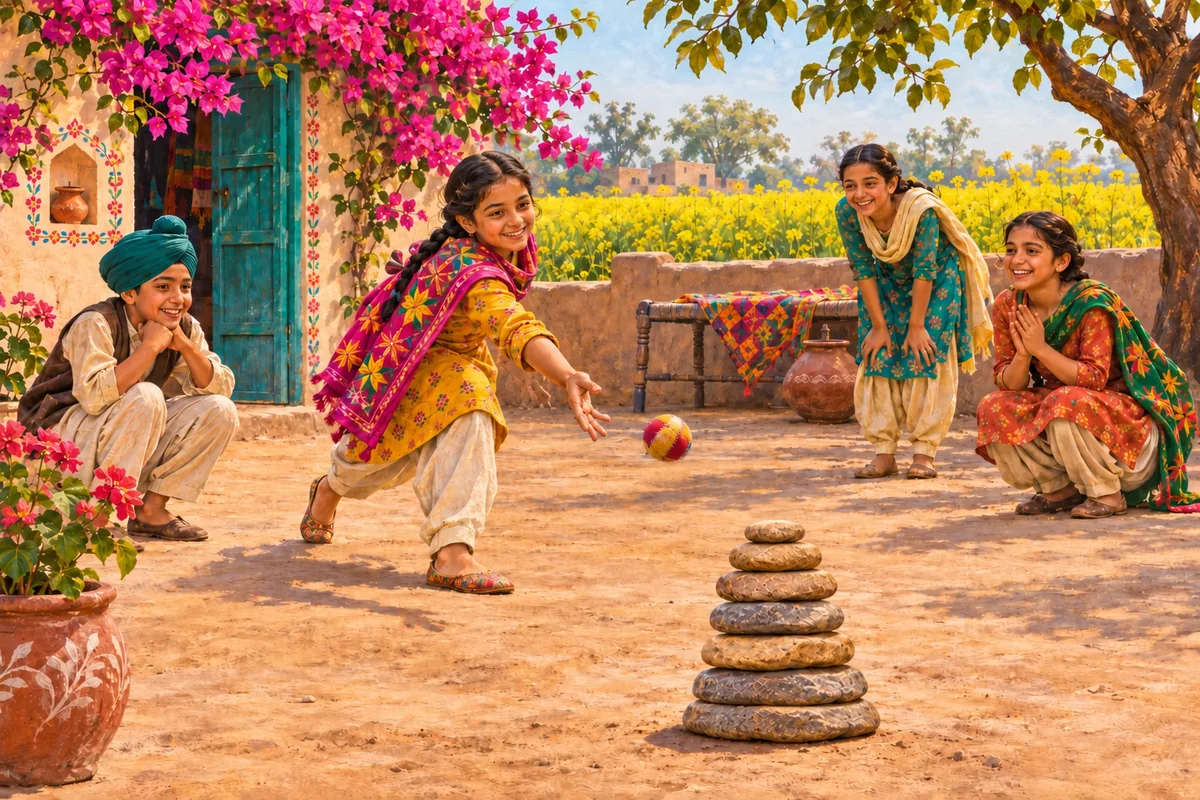
Pitthu garam vich ikk team ball maar ke chhoti dheri dhaah dindi ae, fer us nu dubara banaun di koshish kardi ae. Duji team ball chukk ke usaari karan wale khidarian nu out karan di koshish kardi ae. Lagori te satoliya varge naa is vaddi khed-parivaar naal jurde ne. Kinne patthar, kinne throw ate jitt di kehri shart hove, eh gallan pehlan tai karo. Nave khidarian nu hauli round naal ball chukkan ate dheri banaun de role dikhau. Naram ball, chikne tukre ate sir wal throw ton parhez khed nu sohni sanjhi sargarmi bana sakde ne. Aakhri tukra rakhhan di jaldi hi is da maza ae.
Pind te ilaqe mutabiq naa ate asool badal sakde ne. Apni riwayat sanjhi karde hoye thaan, samaa ate sikhaun wale bande da naa daso. Tafseeli lekh de hawale vi parho; ajj di tabdeeli nu purani riwayat ton vakh pachhano.
Poora khoj lekh — English
Pithu garam turns a small stack into the centre of a fast team game. One side throws a ball to scatter the stack, then tries to rebuild it. The opponents retrieve the ball and attempt to put the rebuilding side out before the pile is complete. The same broad family of games appears under names including pitthu, lagori and satoliya.
The Bharatiya Khel learning resource describes the knock-down and restack sequence as the heart of play. The Traditional Games Federation of India’s version uses seven stones or suitable substitutes and a ball, with teams alternating attacking and defending roles. A game can therefore be set up with little equipment, while still rewarding throwing accuracy and cooperation.
Exact rules differ. Groups may use different throw limits, ways of counting an out, scoring targets and conditions for a completed rebuild. Those details should be settled before the first throw. Two neighbouring groups can agree on the basic game and still remember a different finish.
A friendly introduction can begin with a slow demonstration: scatter the stack, show how the ball is retrieved, then let one player practise rebuilding while teammates make space. Once everyone understands the roles, choose a short score or time limit and swap sides fairly. That suggested teaching sequence is an adaptation for a mixed group, not an official Punjabi tournament rule.
Choose a soft ball and smooth stacking pieces, and agree that throws at the head are excluded. Young children can use foam pieces or other lightweight substitutes. The pleasure is in the sudden change from careful aim to a shared scramble—the call to a teammate, the nearly rebuilt stack and the last piece placed before the ball returns.