Full research text is currently in English. Punjabi titles and reading versions are being expanded.
The tin above the stove
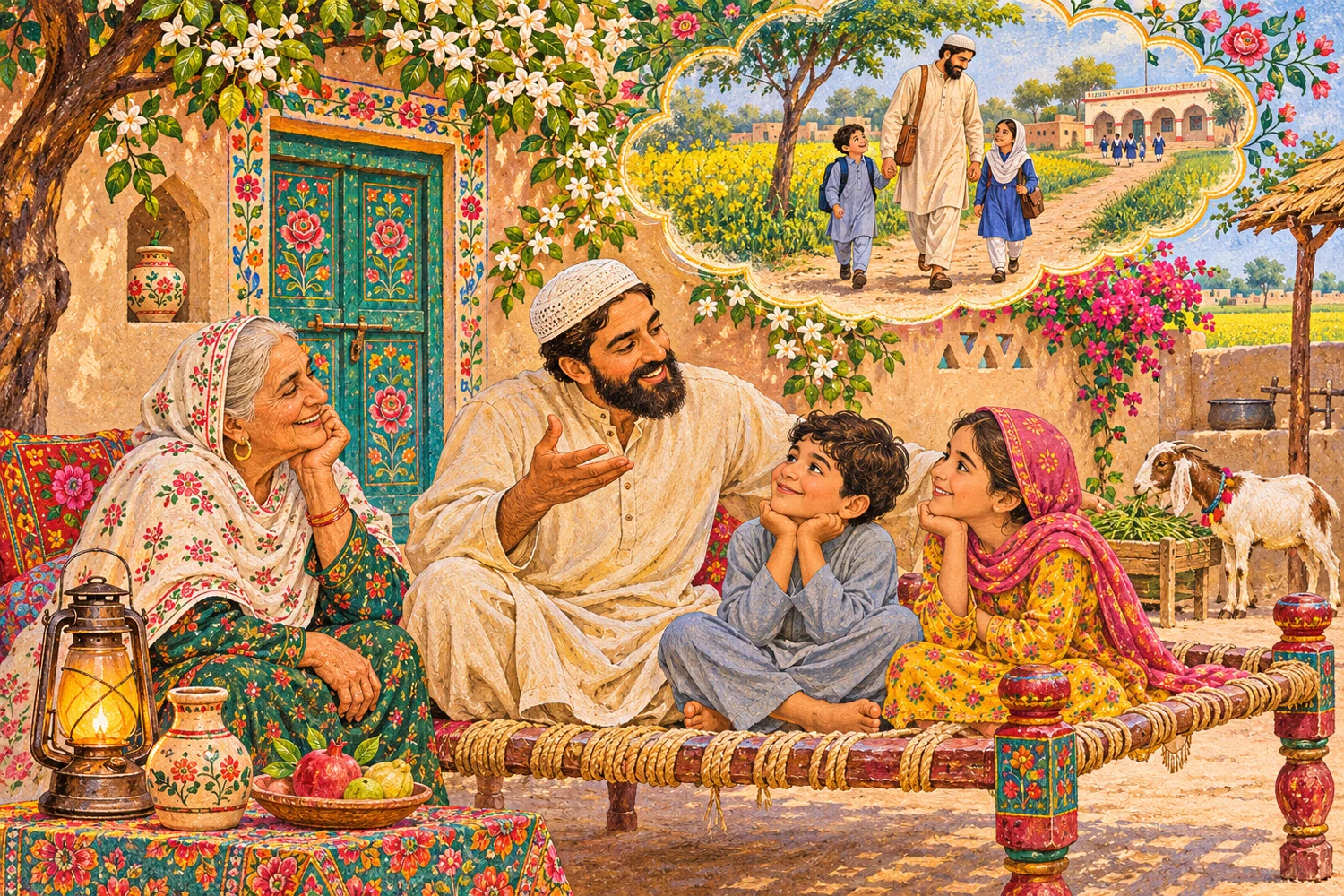
Aiman had promised to carry only what would fit into one suitcase. On the last afternoon in Kasur, Bebe set a round biscuit tin on the courtyard table. The lid was so stiff that you had to brace it against your stomach and pull with both hands. Inside lay a school photograph, two buttons and a brass key. Aiman took out the photograph first. Bebe told her to put it back until her uncle arrived. He was the only one who could say which boy had tied his necktie on backwards.
The key had a loop broad enough for a child’s finger. Aiman had assumed it was for the courtyard, where the wooden door sometimes swelled in the rain. Bebe said it opened a shop that had closed before Aiman was born. Her grandfather repaired umbrellas there. In the monsoon people brought them in wrapped in old newspapers. Bebe used to stand on a stool to find the bundles that had dried above the counter.
The umbrella shop
Aiman said she remembered her grandfather only as a man who sat on the roof with his tea. Bebe took a sheet torn from a school notebook and folded it into a rectangle. The shop counter, she said, had been just about that shape. She drew the stool where Aiman’s uncle used to do his homework. Then she drew a mark beside it to show where an umbrella could be opened without knocking the scales off the shelf next door.
When her uncle came, he placed his spectacles on the table and picked up the school picture. The boy with the tie was him. He remembered a teacher straightening it and somebody twisting it back before the shutter clicked. Aiman reached for her phone, then asked him whether she could record the story. He leaned in and gave his whole name, as if he were at a railway counter and the person on the other side could be anybody.
What went into the suitcase
Bebe kept the key. Aiman packed the rectangle of paper between two shirts. By the time she reached the airport, it had picked up the crease of the suitcase lining. She sent her uncle a photo and asked what stood on the site now. He said he would walk past the next day. He thought it was a tailor’s shop, but the shutters had been down the last time he passed.
Two weeks later, on a call from her new room, Aiman unfolded the map. The stool was a little square in pencil. She asked Bebe why there was a second square under the counter. Bebe laughed. That was where Aiman’s father used to wait out the rain. He was small enough to fit and old enough to pretend he had gone there to look for something.