Full research text is currently in English. Punjabi titles and reading versions are being expanded.
Who called the line
The night it rained in the village outside Barnala, Gurkirat left the wooden danda under the shop awning. At breakfast he found it beside the drain. The mud had printed half a leaf on the handle. He wiped it on his shorts and went looking for Simran, who could pitch a gulli high enough to give herself time to turn before she swung.
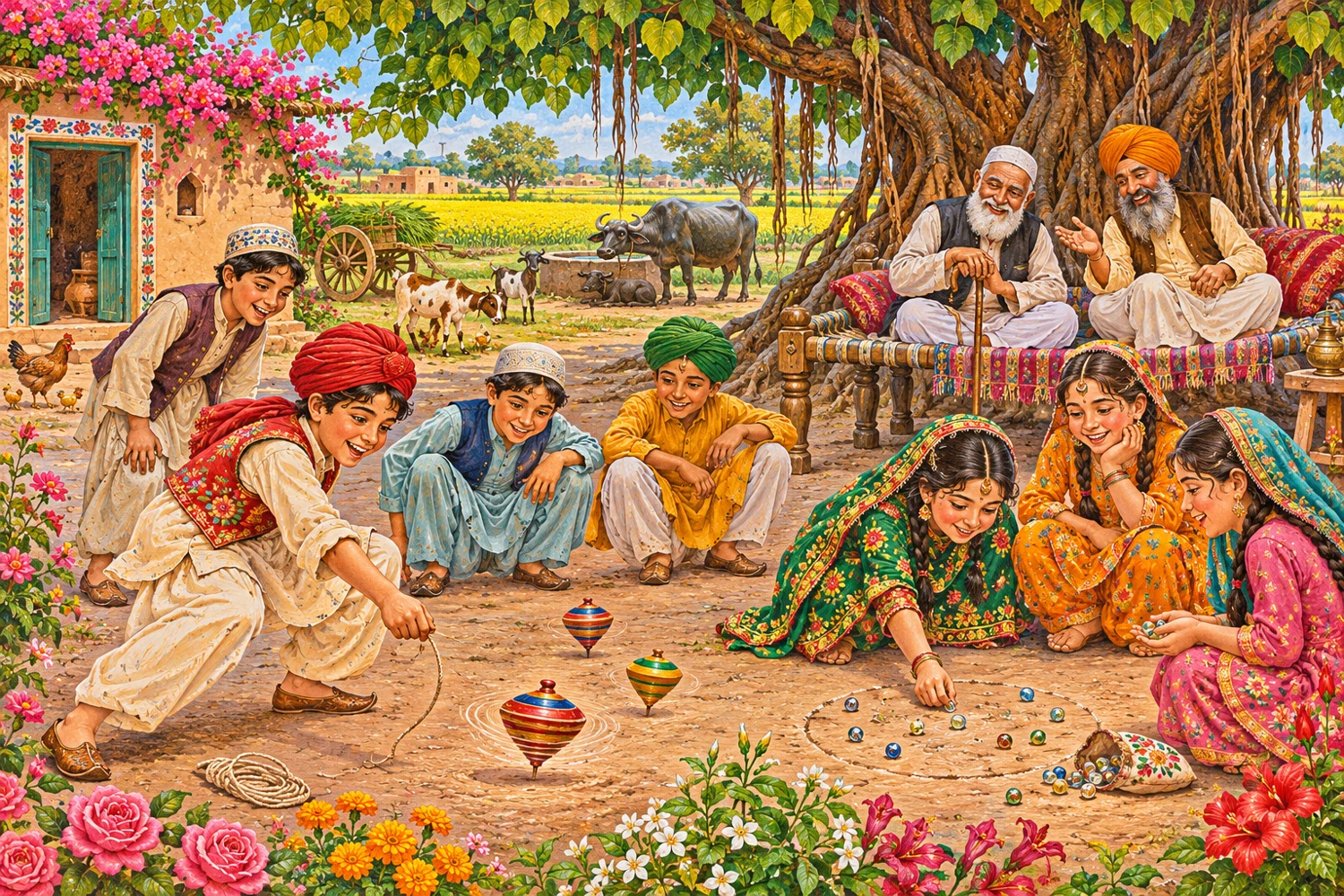
They had been playing on the same patch since school closed for the summer. The boundary ran from a broken brick to the water trough, except on the days an animal stood drinking there. Everyone agreed the boundary moved then. Nobody agreed where. When Simran struck the gulli that morning it dropped beyond the brick, into a strip that had been hard earth the day before. Gurkirat called it out. Simran said he had been looking at his feet.
The girl with the chalk
Jasleen had come with a piece of chalk in her shirt pocket. She took the smallest children over to the dry wall and asked them to watch the brick. One would mark each swing and another would tell her where the stick landed. It took the youngest nearly a minute to make the first tally. The players waited, partly because the lane was still wet and partly because nobody wanted to be the first one she ruled against.
On the third turn, Gurkirat sent the gulli into a patch of grass by the trough. A little boy found it and held it up like a prize. Simran said he should take the next turn. Gurkirat protested that the boy couldn’t lift the danda. Jasleen went to her house and came back with a shorter piece of wood. She rubbed one end on the step until the splinter was gone.
The rule that stayed
By the next week, the water had dried and the wall still carried the marks. The smallest boys and girls now played between two closer bricks, while the others played on the long side of the lane. When a tractor came they each knew who was supposed to gather the sticks. Simran still pitched the gulli high. Gurkirat still tried to call the difficult ones. From the wall, Jasleen told them to wait until the child watching the line had spoken.
Years later, Gurkirat could remember the colour of the chalk and the taste of the tea the shopkeeper brought when they were done. He could never settle who had won that morning. The old boundary was under new paving, and in the photograph someone sent of the lane he found himself looking first for the wall.