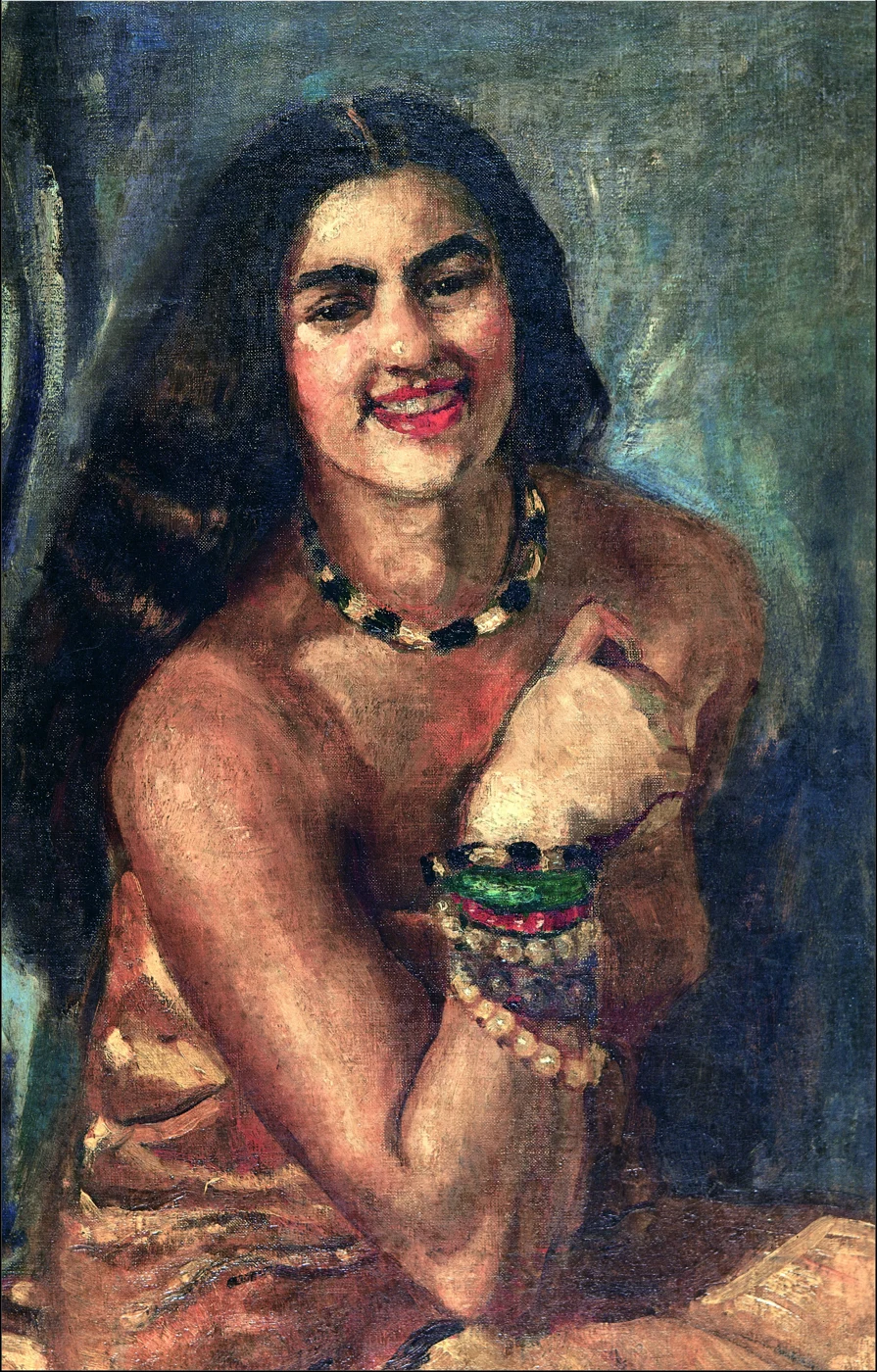
Amrita Sher-Gil da janam 1913 vich Budapest vich hoya. Ohde pita da parivaar Punjab naal judya si, te ohdi parhai Paris tak gayi. 1934 vich India auna ohdi kala layi vadda mor si. Oh aurtaan te rozmarra de lokan nu gaur naal chitrdi si. 1941 vich ohdi Lahore vich maut hoi. Ohdi zindagi dasdi hai ke banda kai thavan te boliyan naal ikko vele jud sakda hai. Ohde chittar sanu tasveer de lokan nu sirf sohni sajavat samajhan di thaan, apni soch te zindagi wale insaan samajhan layi kehnde ne. Jadon asin pind, khet jaan parivaar di tasveer sanjhi kariye, taan puchhiye ke ohna lokan di apni gall te marzi vi tasveer vich jagah paa rahi hai?
Poora khoj lekh — English
More than one home
Amrita Sher-Gil was born in Budapest in 1913 to Umrao Singh Sher-Gil and Marie Antoinette. Her father’s family connected her with Punjab, while her education and early artistic life took her to Europe. She studied in Paris and returned to India in 1934. The National Gallery of Modern Art describes this return as a turning point in her work. She died in Lahore in 1941, aged twenty-eight.
Her life complicates a narrow idea of belonging. A person can inherit one place, grow up among several languages and develop a voice through encounters elsewhere. The useful question is not whether that person fits a simple label. It is how those experiences change what they notice and how they choose to represent it.
People in the frame
NGMA’s collection and exhibitions include works such as Group of Three Girls, Bride and Brahmacharis. Her paintings of women and rural people helped form a distinctive part of modern Indian art. Looking at the works themselves is essential: colour, posture, distance between figures and the pace of a scene can express meanings that a short biography cannot replace.
For a website seeking a vivid picture of Punjab, her example is especially useful. A field, a village or a group of women should not appear only as attractive background. People have interior lives, unequal circumstances and choices of their own. An image can be beautiful while also inviting a viewer to ask who is being seen, who is doing the looking and whose experience remains outside the frame.
An invitation to look again
Sher-Gil’s short life left a body of work that museums continue to study and exhibit. A responsible introduction should distinguish the artist’s own paintings from later tributes and imagined illustrations. It should also identify where a work is held and respect the conditions attached to reproducing museum images. Readers can follow the NGMA links to explore her work in its collection context.
Her relevance to Sadda Punjabi Virsa is not restricted to fame or a family connection. She offers a way of thinking about representation itself. When we photograph an orchard worker, an elder on a charpai or children returning from school, are we making them decorative, or allowing something of their lives to remain present? Have they agreed to the photograph and its use? What would they choose to tell us about it?
These are questions an image-rich community website should keep asking. Celebrating Sher-Gil can mean learning to see with greater attention, not simply adding a celebrated name to a list. Her work reminds us that a culture stands out most strongly when the people within it are allowed to be complex, thoughtful and fully human.