Mirza Sahiban Punjab da mashhoor qissa hai, jis da Pilu naal judya roop khas ahmiyat rakhda hai. Eh saadi chhoti peshkaari hai, poori tasdeeqshuda tareekh nahi. Mirza te Sahiban bachpan ton ik duje naal judde ne. Sahiban da viaah hor thaan tai hove taan oh Mirze nu suneha bhejdi hai. Mirza ghori Bakki utte aunda hai te donon nikal turde ne. Aaraam vele Sahiban nu bhra aunde disde ne. Mashhoor roopan vich oh khoon-kharabe ton dardi Mirze de teer tod dindi jaan hathiyaar door kar dindi hai. Ohdi aas poori nahi hundi te qissa dukhaant vich mukda hai. Kise gaayak di ikko vyakhya nu aakhri sach na manniye. Sahiban nu ilzaam tak ghataun di thaan, pyaar, rishtedari te hinsa de dabaa vich ohdi aukhi chon nu vi samjhiye.
Poora khoj lekh — English
A story carried in performance
Mirza Sahiban is one of Punjab’s enduring tragic romances. The qissa associated with Pilu is especially important to its performance tradition, while oral and later written versions vary. This page offers an original, condensed prose retelling. It does not treat a folk narrative as a fully verified historical record, and it does not assume that one familiar song contains every version.
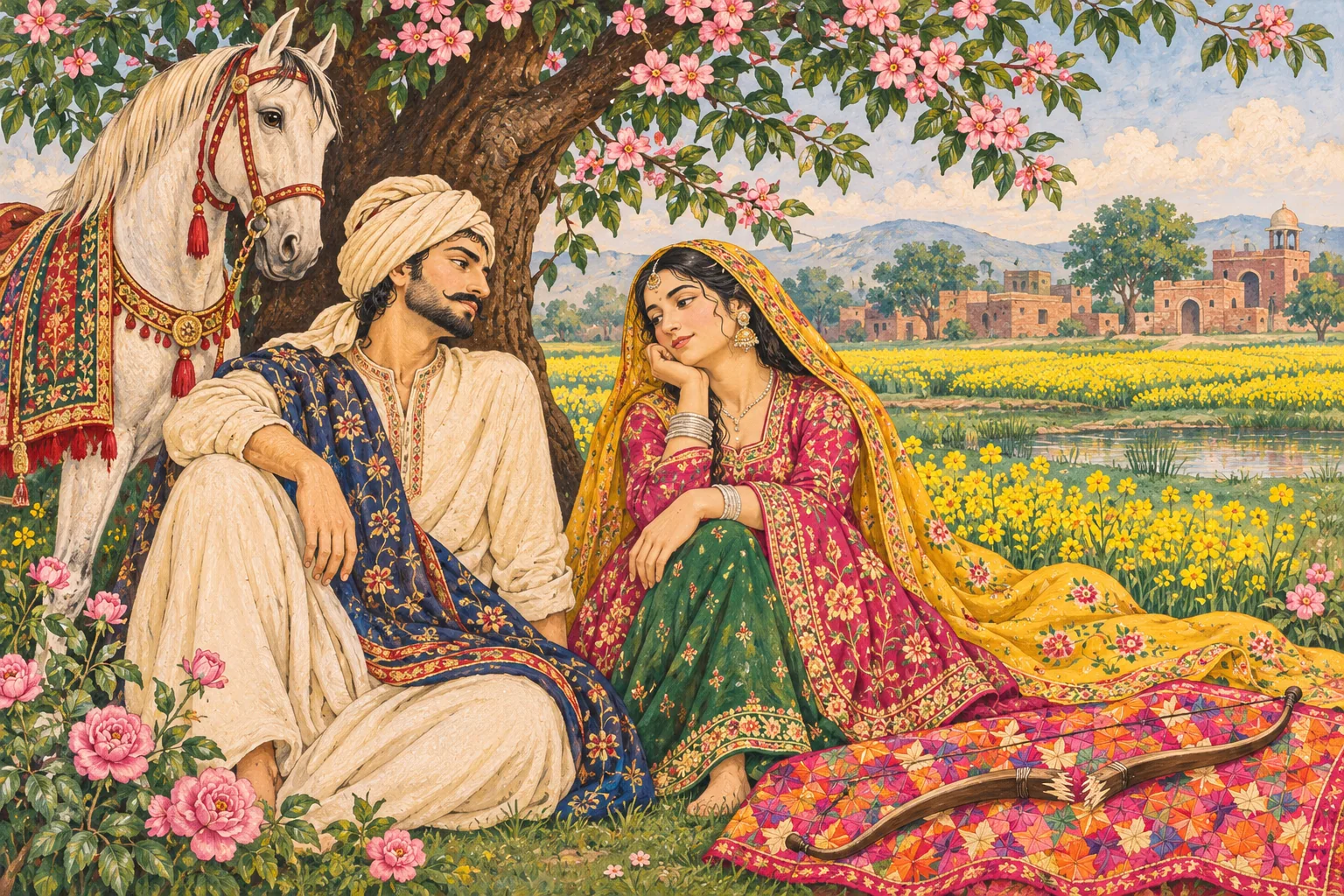
Mirza and Sahiban grow close while young. Their relationship is interrupted by the plans of their households, and Sahiban is promised in marriage elsewhere. She sends word to Mirza. Riding the mare Bakki, he comes for her, and the two leave together. The horse gives the story movement and urgency: the lovers are trying to cross a distance before the surrounding social world can close upon them.
The choice under the tree
In the familiar scene, they stop to rest beneath a tree. Mirza sleeps while Sahiban sees her brothers or pursuing relatives approaching. She fears what will happen if the skilled archer fights them. In different tellings she breaks his arrows, moves his weapons out of reach or otherwise prevents the expected clash. Her hope that violence can be avoided is not fulfilled. Mirza is killed, and the qissa ends in tragedy for Sahiban too.
The episode has encouraged generations of argument. Some performances accuse her of betrayal. Other readings hear a person caught between love and kinship who tries to prevent bloodshed. The differences matter. A reader should not be told that one harsh judgment is the only meaning available, or that violence is the natural test of the lovers’ sincerity.
What happens when a woman becomes a verdict
To read Sahiban only as the explanation for Mirza’s death is to give her a narrow role in a much larger conflict. Households have arranged a marriage, armed men are pursuing the pair, and reputation has become a reason for coercion. Asking about her choice does not require declaring every action wise; it requires allowing her more complexity than a slogan.
The same attention can be given to Mirza. Skill, courage and confidence do not remove vulnerability. Nor does admiring a legendary rider mean that readers should romanticise elopement under threat, revenge or the killing of relatives. The qissa gives us a place to discuss those pressures; it is not a rulebook for living them out.
Keep the versions in conversation
When adding a family’s version to the community, record the language, the singer or elder who taught it and any lines remembered exactly. If a detail is uncertain, say so. The spelling of a place or a character’s name can vary without making the memory worthless. What matters is keeping the account attached to its teller and context.
Mirza Sahiban belongs to a landscape of horses, trees, distance and kinship, but its continuing force lies in the question of how people interpret a difficult act. A shared Punjabi reading room can hold competing readings without humiliating the people who bring them. Before repeating a verdict about Sahiban, it is worth hearing the story again from the place where she stands.