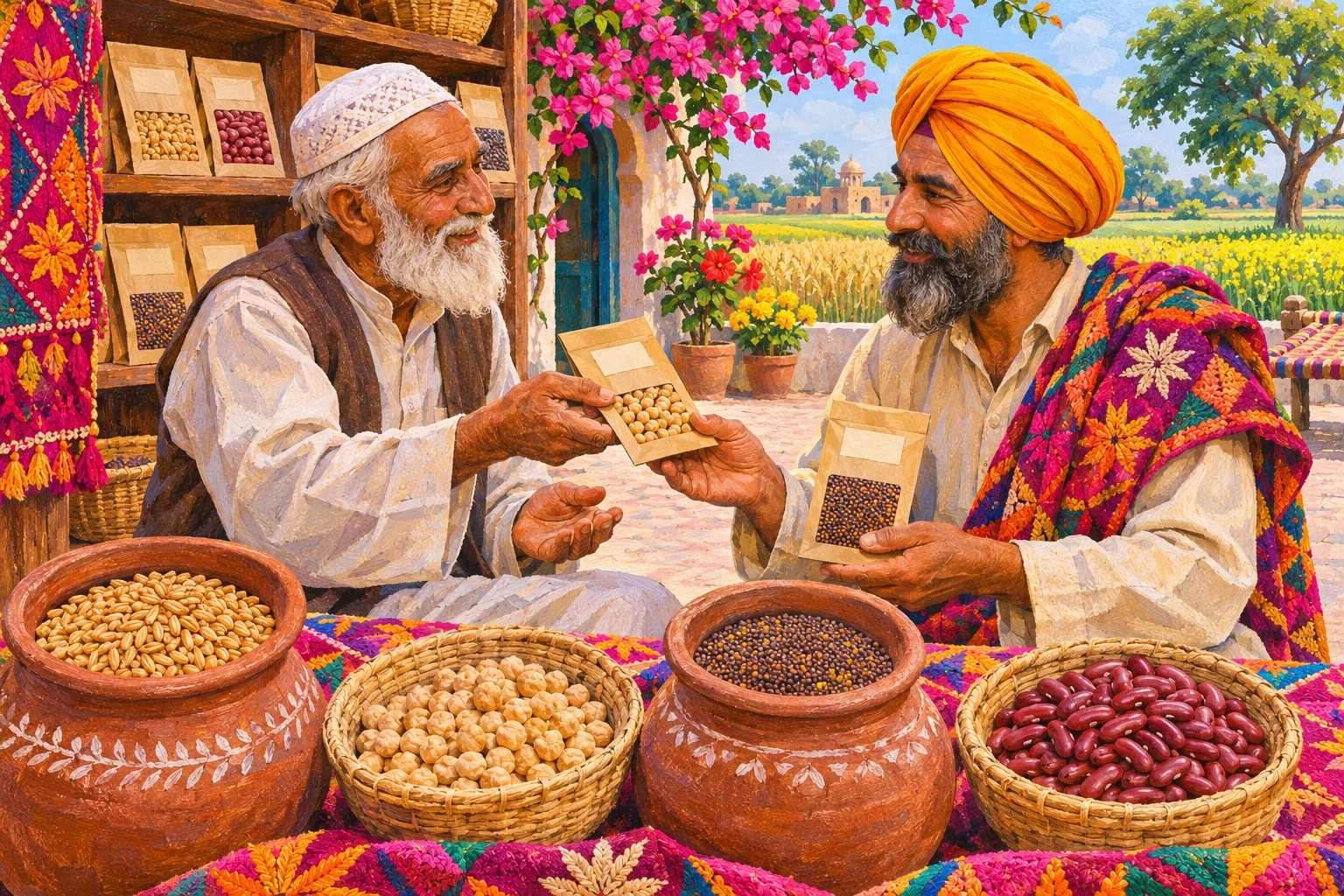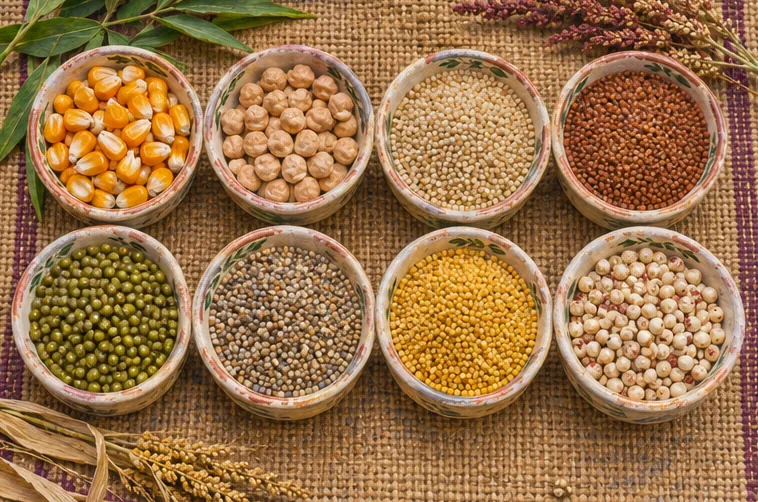
Desi ik pyara te zaroori lafz ae, par eh apne aap beej di poori pachhaan nahi dassda. Puchho: eh kis fasal di kehri kisam ae, kithon aayi te kinne saalan ton is khet vich ug rahi ae? Khulle paragan wali kisam da beej theek dhang naal sambhaleya jaave taan agli fasal aam taur te ohde varge gun rakh sakdi ae.
F1 hybrid do chuniyan maape-kismaan de mel di pehli nasal hundi ae. Ohda bachaya beej zaroori nahi banjh hove, par agli nasal vich gun vakh ho sakde ne. Hybrid, genetically engineered te organic ikko gall nahi. Organic kheti da tareeqa te, jithe laagu hove, tasdeek da miyaar ae.
Kisaan beej da kharcha, bimari, mandi, fasal di iksaarta te mehnat vekh ke chon karde ne. Desi kismaan di sanbhaal karo, par har kisam nu apni mitti te paani vich azmao. Kinnow vi hybrid asal rakhda ae te Punjab de baaghan da hissa ban chukka ae. Maqsad kisaan di samajh, beej di vann-suvannata te chon mazboot karna ae.
Poora khoj lekh — English
What does desi tell us?
Desi is a meaningful local word, but it is not a complete technical description. It may refer to a family-kept crop, a locally familiar form, an older variety or simply a seller's marketing language. Ask what it means in this particular case. Where was the material collected? How many seasons has the keeper grown it? Is it an open-pollinated variety, a local population, a clone or a recent selection?
Seed conservation becomes more convincing when the description can be checked. A local name and an elder's account matter, but so do the crop's identity, health and suitability for the intended use.
Open-pollinated and F1 are breeding descriptions
An open-pollinated variety can reproduce broadly similar characteristics when its seed is produced and selected appropriately. Isolation and population size still matter, especially in crops that readily cross with neighbours. An F1 hybrid is the first generation from a planned cross. Saved seed from that crop is not necessarily sterile; its offspring can segregate and no longer give the same uniform result.
University extension guidance describes potential hybrid advantages including uniformity, vigour and useful resistance traits. It also explains why seed saving from open-pollinated material is often more predictable. Those are trade-offs to examine, not reasons to assume every old seed is excellent or every hybrid is unsuitable.
Organic describes the production system
Organic production concerns how a crop is managed and, where products are sold as certified organic, the applicable standard and certification. It is not simply another name for an old variety. Seed treatment, permitted inputs, field history and record keeping can all matter. A traditional seed does not turn a chemically managed field into a certified organic farm merely by being planted.
Likewise, hybrid and genetically engineered are not interchangeable terms. Good educational content should keep breeding method, legal rights, seed treatment and farming practice distinct. Readers should be able to understand the choices without being pushed towards claims that the evidence cannot support.
Why farmers changed their seed
Farmers may choose a variety because a buyer wants a uniform product, a disease has become costly, labour is scarce, harvest timing matters or the expected return covers the seed cost. A realistic revival project asks about those pressures. It should help a grower identify a viable market and suitable management rather than asking the household to absorb an unmeasured loss.
Modern public varieties also deserve attention. Punjab Pakistan's Maize and Millets Research Institute lists both open-pollinated varieties and hybrids. The choice is not limited to an ancestral packet on one side and a commercial hybrid on the other. Ask for the exact variety and its regional recommendation.
What should be brought back?
There are strong reasons to conserve locally adapted diversity, family seed knowledge and crops with distinctive taste or uses. A sensible first step is a small trial with a written comparison of germination, yield, disease, water, input costs and sale or household value. Keep promising traditional material in cultivation, document weaknesses and seek improvement where needed.
Orchards provide a helpful reminder about labels. Kinnow is closely associated with Punjab, yet the University of California, Riverside documents its hybrid parentage. Cultural belonging and breeding history answer different questions. Our goal is to strengthen farmer choice and seed diversity through accurate information, not to replace one blanket claim with another.