2026 de parliamentary jawab vich Indian Punjab di 2025 groundwater assessment extraction nu assessed resource ton vadh dikhaundi ae. Eh saare khuhan da live haal nahi, na har zille di iko raftaar da daava ae. Block, samaa ate unit naal ankra parho. PAU di Sangrur extension misaal direct-seeded rice nu munasib variety, laser levelling ate weed management naal jorhdi ae. Sirf bijai da tareeqa badalna saara hal nahi. Khet de muqable vich paani, mehnat, bijli, ghaah ate harvest ikatthe likho. Kisaan de equipment, hunar, risk ate hor fasal di mandi wale sawaal vi suno; tabdeeli ohdon mazboot ae jadon saboot te tajurba ikatthe bolan.
Eh lekh gall-baat te sikhhan di shuruaat ae. Apne khet layi faisla mitti, paani, mausam, kharche ate maqami maahir di salah naal karo. Tajurbe di thaan, tareekh, fasal ate natije likho; ikk changi misaal nu har zameen layi pakka waada na samjho.
Poora khoj lekh — English
A parliamentary answer dated 12 February 2026 reports Indian Punjab’s 2025 groundwater assessment. It gives annual groundwater extraction of 26.27 billion cubic metres against annual extractable groundwater resources of 16.80 billion cubic metres. The reported stage of extraction is 156.36%, and 111 of the state’s 153 assessment blocks are categorised as over-exploited. These are dated assessment figures, not a live reading of every well.
The percentage compares annual extraction with the assessed extractable resource. It is not a statement that every district has the same rate of water-level decline, nor does it describe drinking-water quality or settle a river-allocation dispute. A local account should identify its block and the assessment period before borrowing a statewide number. This makes the scale of the problem clearer without flattening important differences between places.
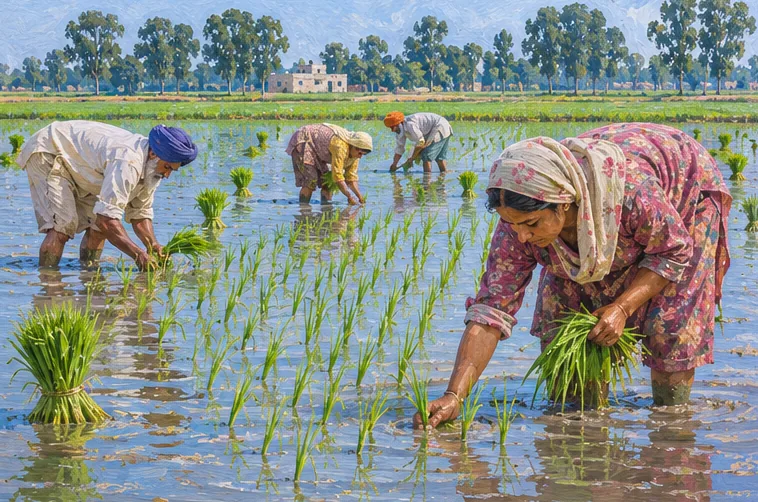
On 2 June 2026, PAU’s Farm Advisory Service Centre at Sangrur reported a Direct Seeded Rice awareness camp at Chhanno. Its extension message linked successful DSR with recommended varieties, laser land levelling and particular attention to weeds. The reported water-saving potential was conditional on following appropriate practices. DSR is therefore a management choice to discuss with local specialists, not a promise that changing the sowing method alone solves the water problem.
For a useful farmer-to-farmer comparison, name the field conditions and record what changed. Was the crop variety different? Was irrigation measured, or only estimated from pumping time? What happened to weed control, labour, energy and harvest? A small demonstration with consistent records can answer a more useful question than a photograph captioned ‘water saved’.
Community discussion should also make room for the reasons growers hesitate: equipment access, timing, skill, risk and the ability to sell another crop. An evidence-led transition listens to those constraints alongside hydrological assessments. Preserve the farmer’s account as experience, keep the official data dated and sourced, and allow different locations to need different responses.