Khet vich paani barabar nahi pahunchda, raah vich ghaata ae jaan sinchai da samaa mitti vekhe bina lagda ae? Har sawaal da hal vakh ho sakda ae. Pakistan Punjab de programme soil-moisture devices, laser levelling ate high-efficiency irrigation varge raah dikhaunde ne. Sarkari listing khareed jaan subsidy da pakka waada nahi; zila, shartan ate kharcha sidha puchho. Muqable layi area, fasal, variety, bijai, mitti, baarish ate har sinchai da record rakho. Sirf pump da samaa paani di miktar nahi je flow badal reha hove. Filter, bijli, murammat, hunar ate nehar de head-tail waleyan de haq vi hisaab vich aun.
Eh lekh gall-baat te sikhhan di shuruaat ae. Apne khet layi faisla mitti, paani, mausam, kharche ate maqami maahir di salah naal karo. Tajurbe di thaan, tareekh, fasal ate natije likho; ikk changi misaal nu har zameen layi pakka waada na samjho.
Poora khoj lekh — English
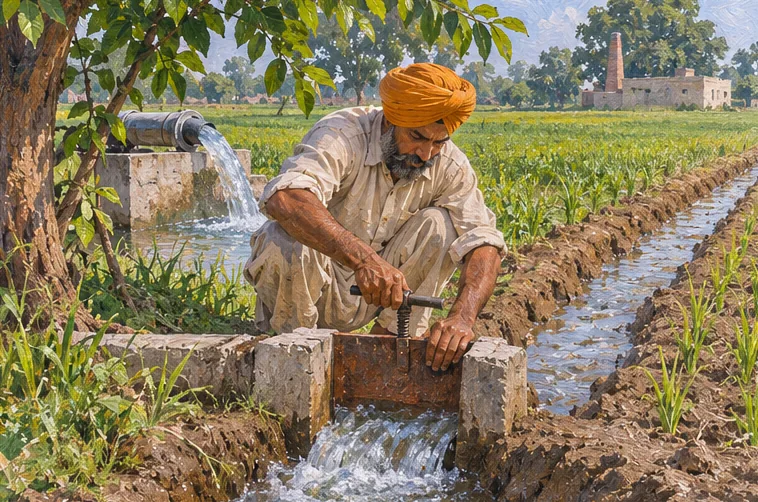
Water-saving technology is most useful when it answers a clearly defined problem. Is the difficulty uneven distribution across a field, conveyance loss before water reaches it, irrigation scheduled without checking the soil, or an unreliable supply? These are different problems. A farmer comparing options needs the crop, soil, field shape, water quality and access arrangements on the same page as the equipment brochure.
Punjab’s historical 2019–20 to 2022–23 pilot on water-use efficiency described soil-moisture devices, alternate wetting and drying, and direct seeding of rice. It included calibration and local standardisation of monitoring devices. The important distinction is that a sensor needs interpretation in its setting; the name of a device does not by itself tell a grower when to irrigate.
The government’s current development listing includes a 2025–26 to 2027–28 Water Efficient Agriculture programme, with conveyance efficiency and head-to-tail equity among its objectives. OFWM service information also describes high-efficiency irrigation and land-levelling support. A programme listing is a starting point for enquiries. Confirm current eligibility, district availability, responsibilities and costs directly before making a purchase or expecting support.
Build a simple comparison record before changing the whole farm. Note the area, crop and variety, sowing date, soil observations, irrigation source and method. For each irrigation, record the date, duration and measured water volume where equipment permits, along with rainfall and pumping expense. Record crop performance and harvest using the same units for the comparison. Duration alone is not water volume when flow changes.
Include the practical work: filtration, repairs, power, operator skill, movement of machinery and the time available between crops. Talk through the plan with local extension staff, particularly where salinity, drainage or uneven terrain complicate the choice. Water management is also social: ask whose turn or access changes when an intervention is introduced. A technology that looks efficient at one point in the system still needs to work for the people and fields around it.